
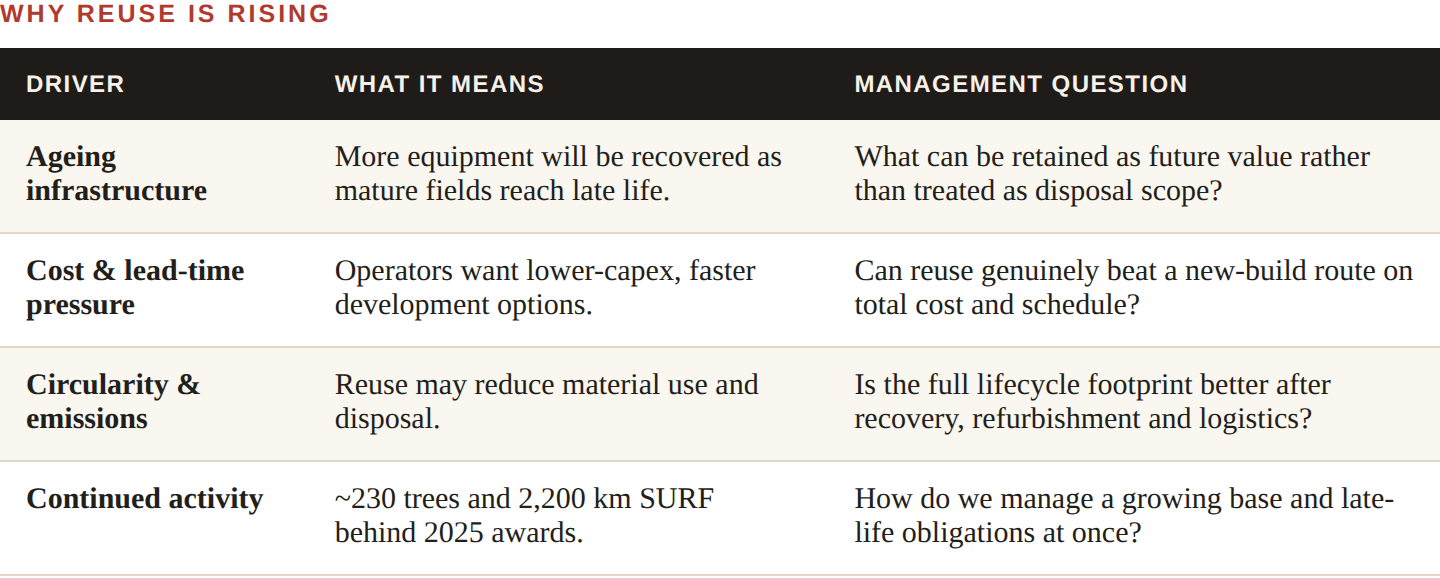
Ageing infrastructure, cost and lead-time pressure, and circular-economy ambition all make equipment reuse more attractive. But unless recovery, refurbishment, qualification and warranty run through a repeatable model, a reused product can take longer and cost more than buying new.
Sreetaran Ponnuthurai · Helios Energy Advisory · 1st October 2026
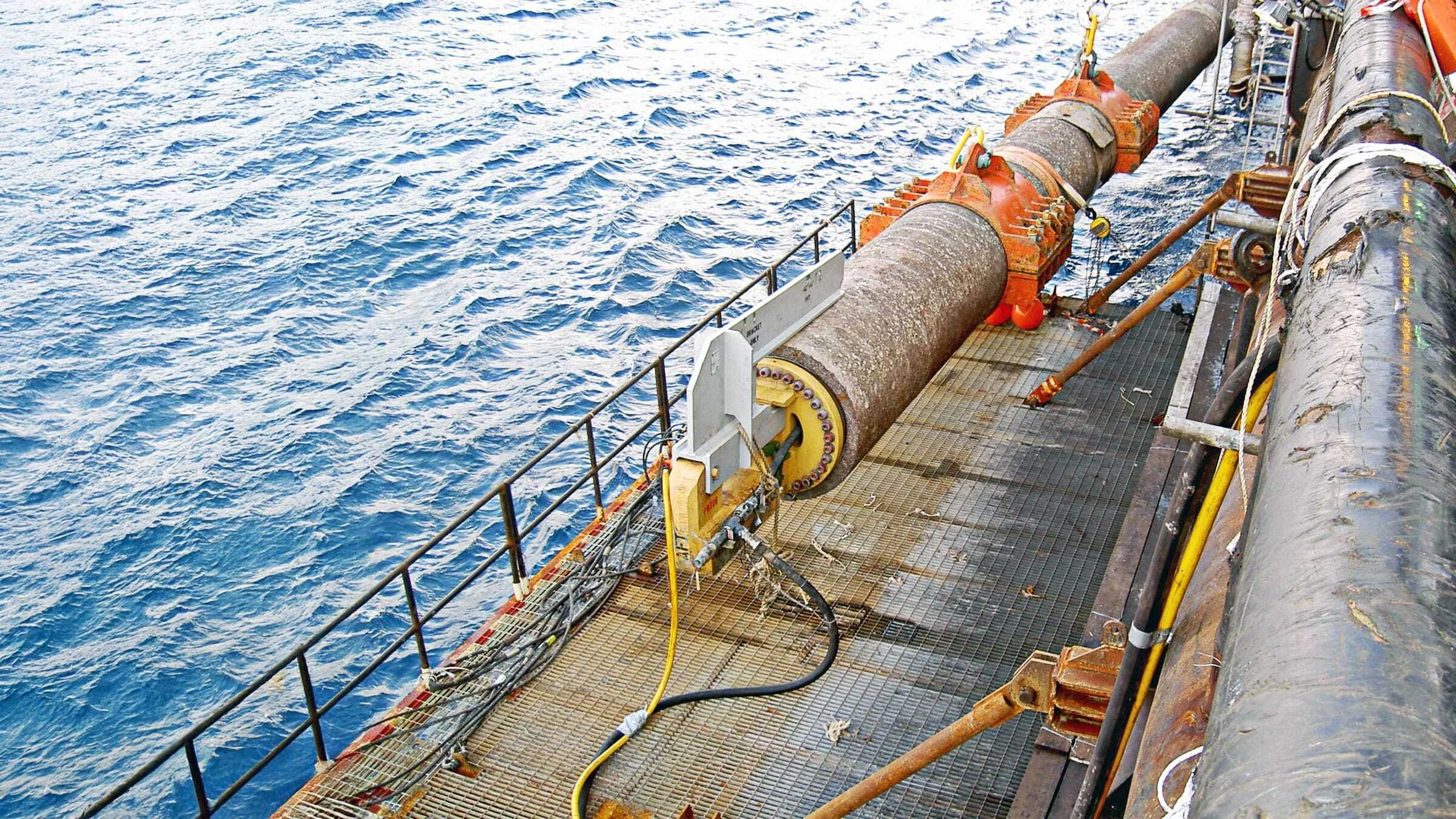
Flowline recovery during an offshore campaign. A recovered product is an option, not yet an available asset — its real condition is unknown until it is back on deck and inspected.
Over close to two decades in subsea, I have watched the industry build an enormous installed base — and I am now watching it begin to take that base apart. As fields mature and operators weigh recovery, late-life intervention and decommissioning, an attractive question keeps surfacing: why manufacture a new product when technically comparable equipment is being recovered from another field? Reuse can create real value. But in my experience it is not a salvage exercise. A recovered subsea product is not automatically an available asset. It arrives with an uncertain condition, an incomplete commercial definition and a technical history that has to be understood before anyone can credibly commit to cost, schedule or performance.

The subsea lifecycle is changing
The industry has spent decades installing trees, manifolds, control systems, jumpers, umbilicals, flowlines and associated infrastructure across the world’s offshore basins. Westwood’s SubseaLogix database now tracks more than 45,000 individual subsea components, and we are still adding more: 2025 subsea EPC awards were associated with roughly 230 tree units and 2,200 kilometres of SURF.
At the same time, operators remain under real pressure to reduce capital expenditure, shorten time to first production and cut material use. Put those two things together and the appeal of reuse is obvious. The difficulty is that the appeal is easy to state and the delivery is hard to guarantee.
The case for reuse
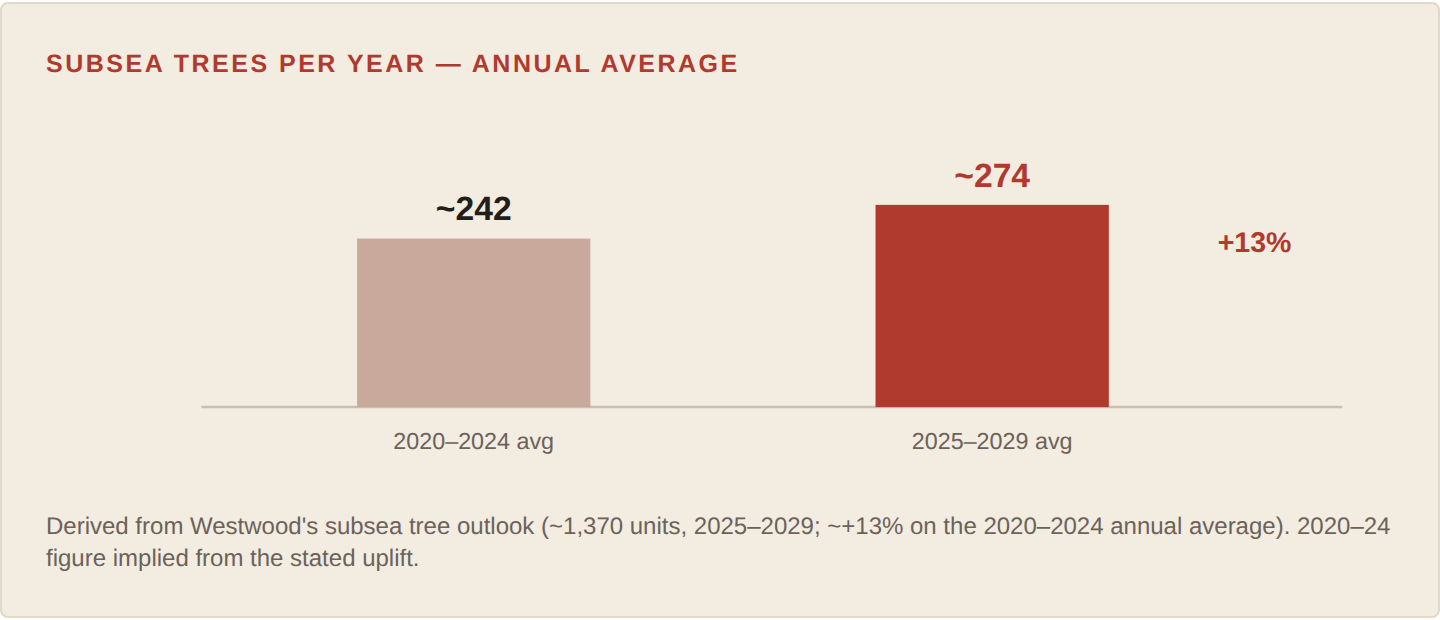
The strategic case is strengthening. Demand for subsea equipment is holding up — Westwood’s outlook points to around 1,370 trees over 2025–2029, an annual average of roughly 274 units and about 13% higher than the 2020–2024 average. Reuse can, in principle, avoid part of the procurement, manufacturing and qualification cycle a new product requires, and reduce material demand and disposal burden along the way.
I would be careful with the carbon argument, though. Recovery vessels, transport, dismantling, inspection, replacement parts, refurbishment, testing and recertification all carry a footprint of their own. The honest question is whether the full lifecycle case is better — not simply whether an existing product happens to be available.
The UK North Sea shows how late-life planning can open the door. The approved decommissioning approach for Spirit Energy’s Birch, Larch and Sycamore developments includes recovering subsea trees, structures and associated jumpers and spools for future reuse, recycling or disposal. It is worth being precise about what that means: the environmental appraisal judged offshore reuse itself not feasible, so the reuse option applies to material once it is recovered ashore, and some trenched or rock-covered lines are to stay in place. Recovery creates an option. It does not guarantee that any given product will be reusable.
A global subsea issue
This is not only a North Sea story. The equipment, the regulatory context and supply-chain maturity differ by region, but the underlying question is global: how can recovered equipment become a source of future value without compromising integrity, schedule or economics?
The North Sea is simply the most mature reference point, because it has had to manage ageing infrastructure earlier and more systematically. The UK North Sea Transition Authority’s Tree and Wellhead Information for Subsea Tooling pilot was set up to improve visibility of subsea wells, trees and wellheads; by August 2025, twelve further operators had contributed data on top of the four original pilot providers. That visibility does not make equipment reusable, but it lets reuse decisions be taken earlier and with more confidence. Brazil shows a different point in the cycle: still a major deepwater growth market, while mature Campos Basin infrastructure generates recovery work — in September 2026 a campaign recovered flexible flowlines, umbilicals and jumpers from a decommissioned FPSO there. The common lesson is that reuse has to be planned before recovery, not improvised once equipment reaches the quayside.
Design life is not reuse readiness
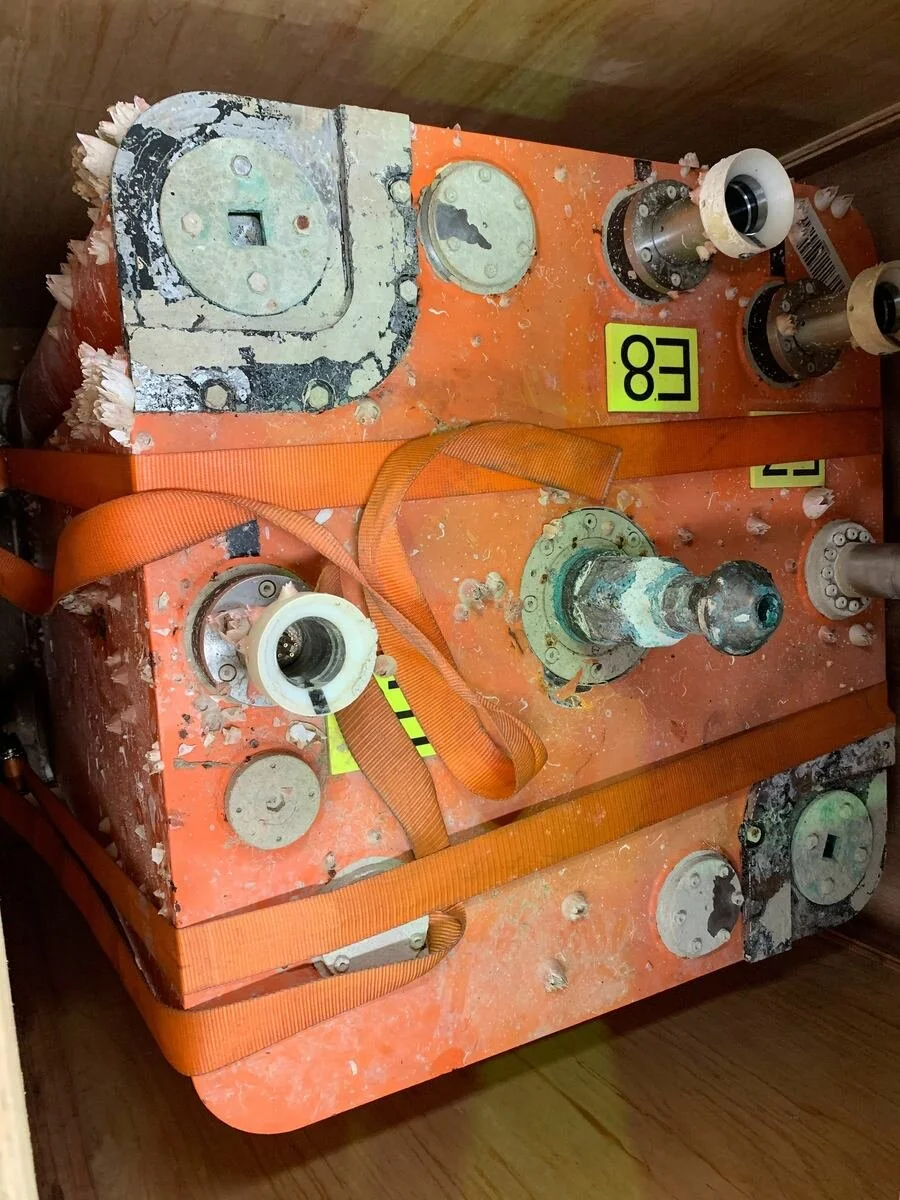
A recovered subsea control module, as landed. Marine growth and surface condition say little about internal integrity — that is settled only by dismantling and functional testing.
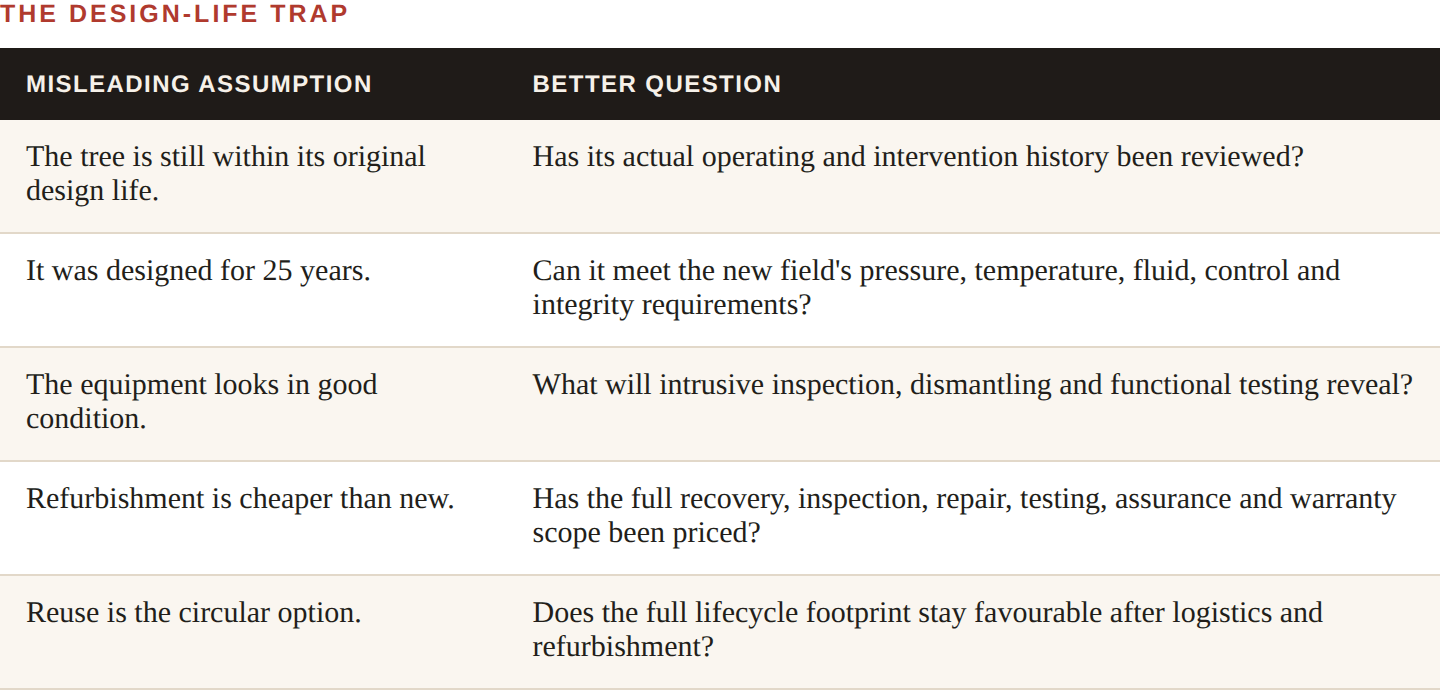
In my experience the most common misconception is the simplest one: that a product still inside its original 20- or 25-year design-life envelope must be cheaper and faster to reuse. Having spent most of my career around this equipment, I have rarely found that to be true. Original design life is not remaining useful life, and neither one tells you whether a product suits a different field. The relevant question is not whether a product is old or new. It is whether it can be shown to be fit for the intended duty — and that depends on operating and intervention history, actual duty cycle, integrity condition, obsolescence, preservation after recovery, documentation quality, compatibility with the target development, and the assurance the operator and technology provider will require. Change only what must change. Prove what must be proven. Do not rebuild equipment merely to make it feel new.
Where the cost and schedule go
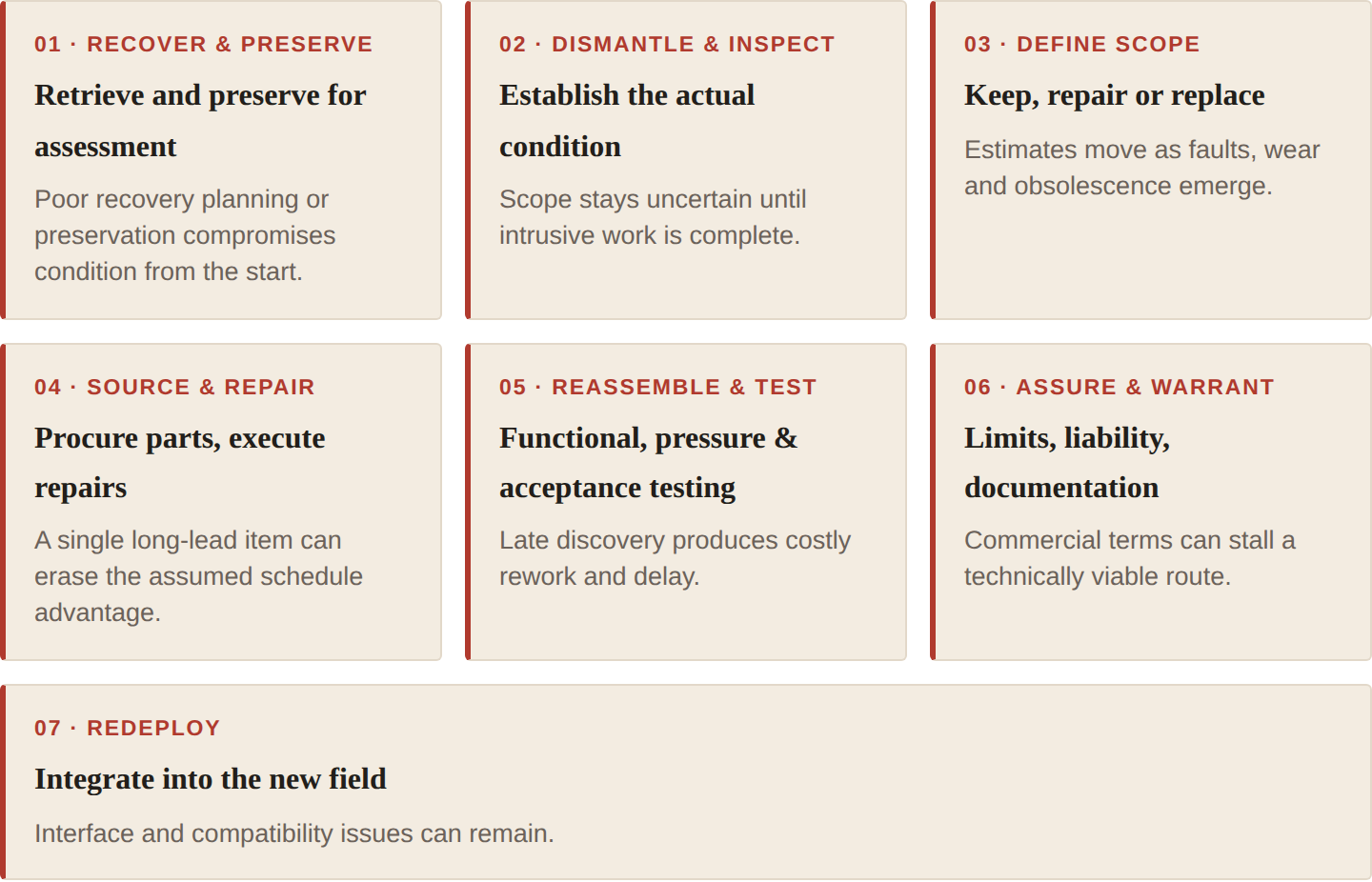
The expected workflow is simple — recover, refurbish, redeploy. The actual workflow is a chain of technical and commercial unknowns, and until a product has been recovered, dismantled and inspected, its true condition and work scope are not fully known.
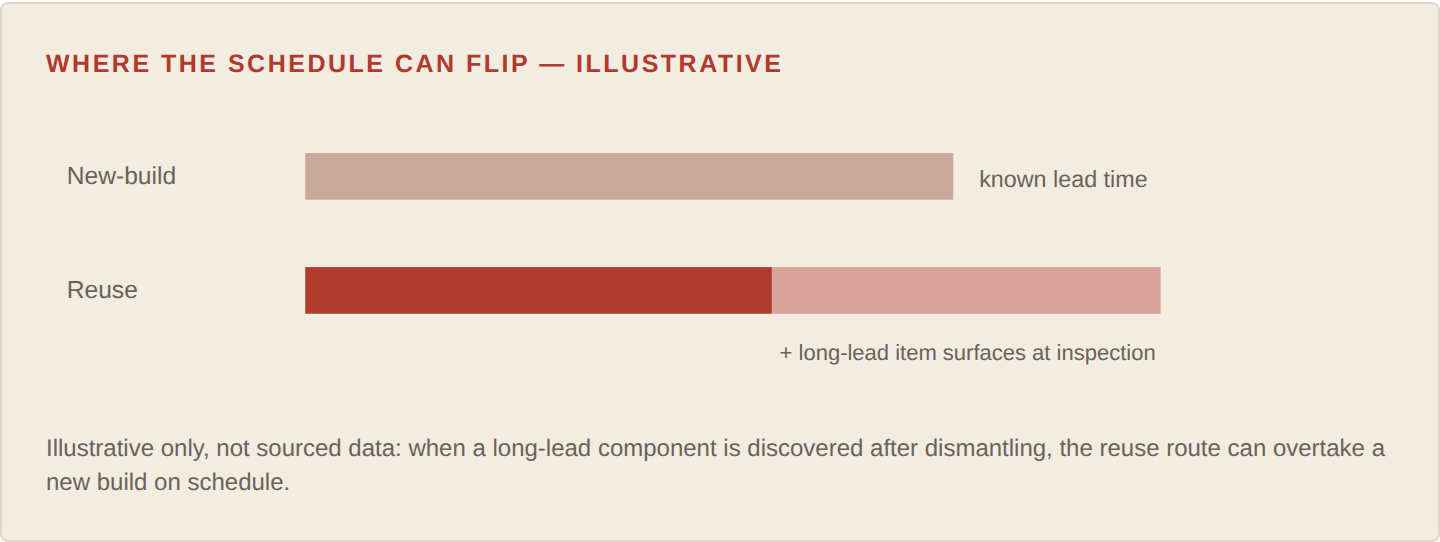
The schedule problem is the one most often underestimated. A worn, faulty or obsolete component may only be identified after dismantling — and if that item is long lead, the refurbishment route can take longer than a standard new build. The cost problem mirrors it: recovery, cleaning, inspection, engineering assessment, repair, replacement, reassembly, testing, documentation and assurance all create work content that rarely appears in a simplistic reuse-versus-new comparison.
Technical uncertainty becomes commercial uncertainty. When a fault is found, operator and provider must decide whether to repair, replace or accept a limitation; who pays; who carries the residual risk; and whether a warranty is still possible. Left late, these questions can stall a perfectly viable option in negotiation. Reuse does not fail because recovered equipment is inherently unreliable. It fails when uncertainty is left unmanaged until the budget and schedule can no longer absorb it.
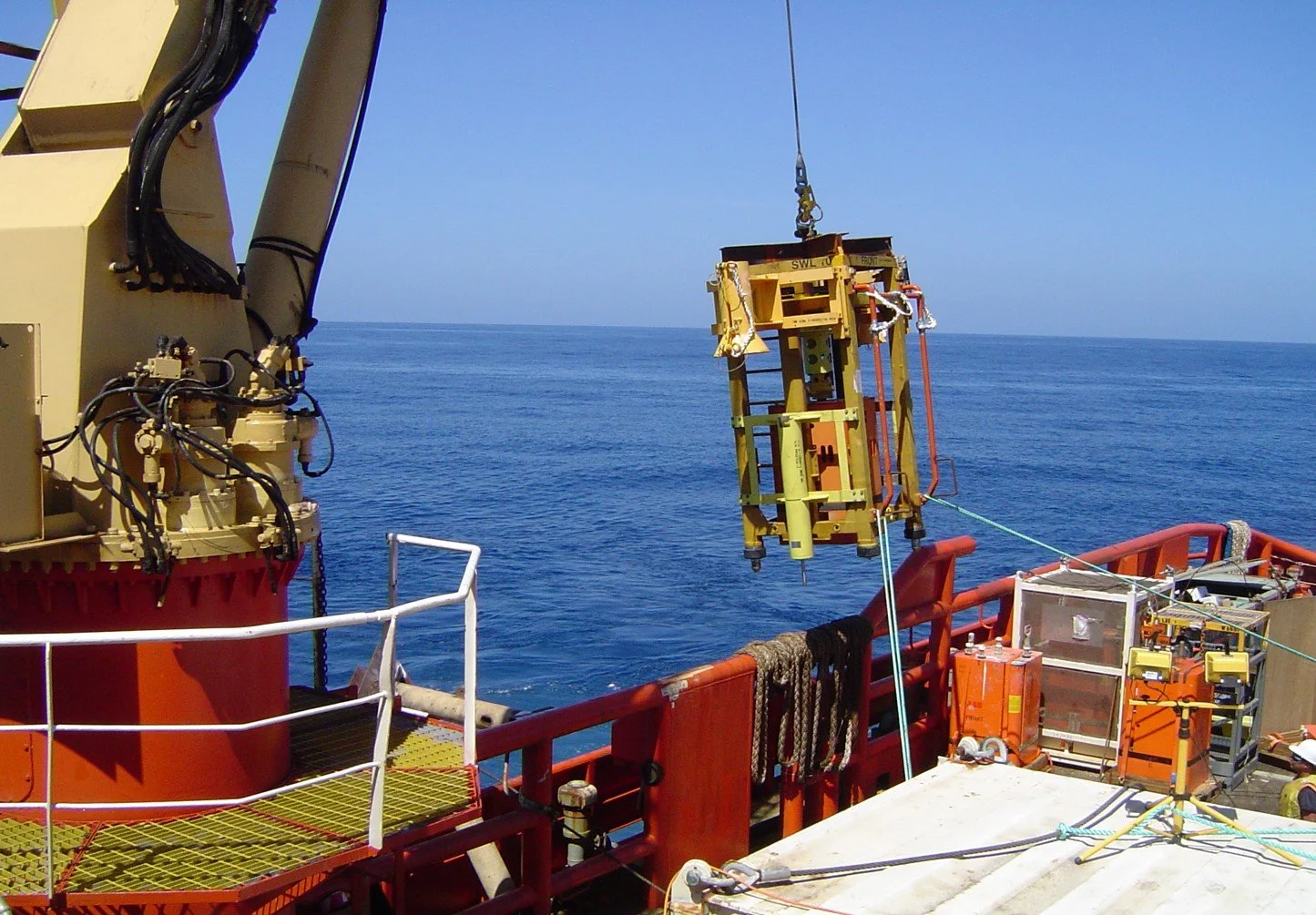
Recovery and handling offshore. The work content between the quayside and the seabed — inspection, repair, testing and assurance — is where reuse economics are won or lost.
What operators need to do
I would treat reuse as an early concept-select decision, not a late procurement initiative. The goal is not a product that looks indistinguishable from new. It is a product with an agreed technical condition, operating envelope, assurance basis and commercial risk allocation.
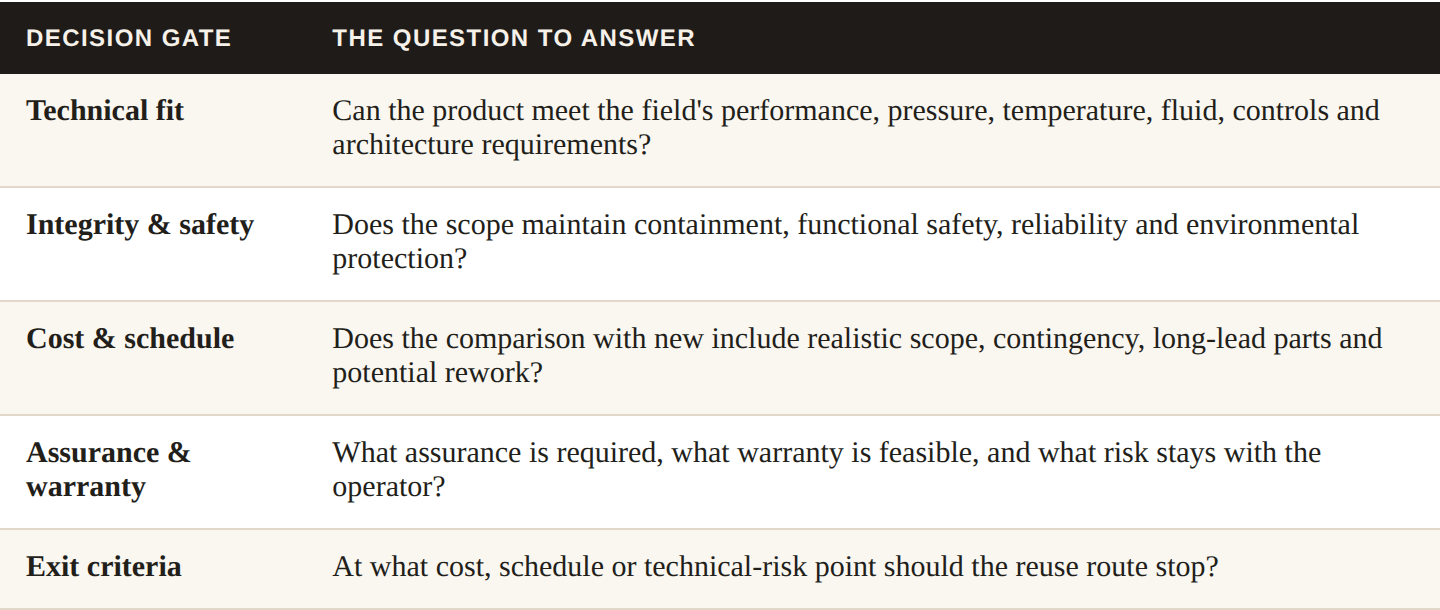
What technology providers need to do
Providers need to stop treating every reuse opportunity as a one-off engineering exception. Not every product can be reused, and not every refurbishment can be standardised — but the process for deciding and delivering reuse can be. A credible subsea reuse blueprint should cover equipment history and configuration, recovery and preservation, inspection and testing, obsolescence assessment, repair-versus-replace rules, a minimum viable refurbishment scope, cost and schedule gates, reassembly and acceptance testing, documentation and traceability, and clear warranty conditions and exclusions. That lets recovered equipment be classified transparently — direct reuse, refurbish-and-reuse, donor/spares, or recycle/dispose. The product may be unique. The decision process should not be.
The potential business model
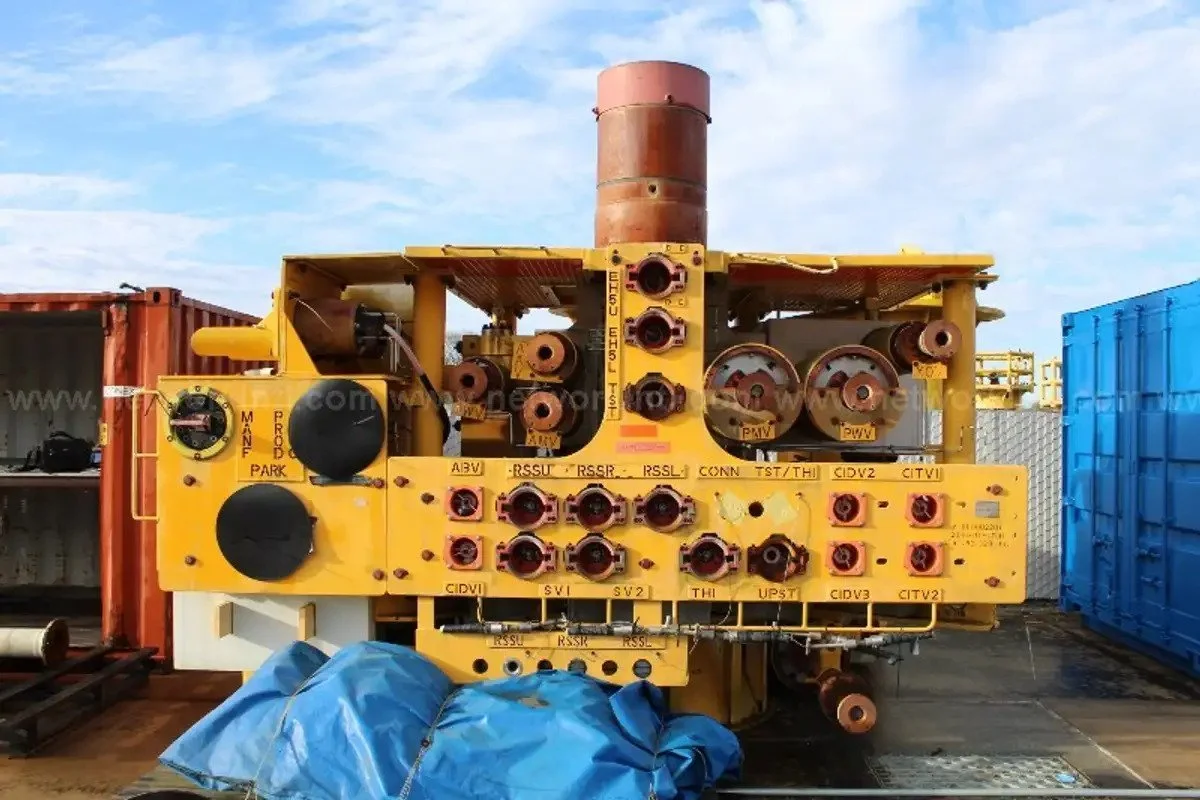
A subsea tree on the quayside. The value of a recovered asset is created not when it lands, but when the industry can prove it is ready to return to the seabed.
There is room for a technology-provider-agnostic reuse integrator — coordinating equipment screening, asset-data capture, recovery planning, preservation, condition assessment, repair partners, testing, logistics, inventory matching and commercial risk-sharing. That would not replace OEM design authority; it would build a more reliable bridge between recovery and redeployment. I would start it selectively — well-understood product families, smaller developments, clearly defined operating envelopes, assets with usable condition history — and let repeated delivery build the data, the supply-chain relationships and the assurance confidence needed for more complex work.
Conclusion
Subsea reuse will grow, because ageing infrastructure, cost pressure, lead-time pressure and material efficiency make the question unavoidable. But it will not become mainstream simply because the industry wants a circular-economy narrative. It will become mainstream when operators and technology providers can assess, refurbish, assure and redeploy equipment with cost, schedule and technical confidence that competes with buying new. The value of a recovered subsea asset is not created when it reaches the quayside. It is created when we can prove it is ready to return to the seabed.
Sources
Westwood Global Energy Group, SubseaLogix (westwoodenergy.com/subsealogix).
Westwood Global Energy Group, Global Subsea Tree Tracker 2025 (tree outlook ~1,370 units 2025–2029; ~+13% on 2020–24 average).
Westwood Insight, Demand for subsea equipment holds (2025 EPC awards ~230 trees, ~2,200 km SURF).
North Sea Transition Authority, Tree and Wellhead Information for Subsea Tooling (12 further operators by Aug 2025, plus four pilot providers).
Spirit Energy, Trees (Birch/Larch/Sycamore) Comparative Assessment & Environmental Appraisal, 2026.
World Oil, MDL technology supports deepwater decommissioning in Brazil’s Campos basin, 16 Sep 2026.
