
Why psychological safety still beats a team of agents that always say yes.
By Sreetaran Ponnuthurai · Founder, Helios Energy Advisory
Most of us will spend the next decade learning how to manage AI agents, whether we chose to or not. The tools are becoming good enough that we will delegate real work to them — research, drafts, reviews, analysis — and the way we manage them will shape the quality of what we decide. It is worth getting right now, before the habits set.
I have been building out a set of AI agents to run my own business-development work at Helios. The system is becoming genuinely useful, but it has surfaced a problem I did not expect. The agents agree with me. Not sometimes, not when I happen to be right — almost always.
I ask one of them to review a draft proposal and it comes back encouraging. I ask another whether my commercial logic holds and it finds a way to say yes. If I push back on its own answer, it folds. For anyone who has spent time running a real team, this feels familiar in the worst way, and it has made me think again about something I thought I already understood: the problem of leading a team that only ever agrees with you.
The leadership lesson, still true
Every experienced leader learns the same lesson. A room full of nodding heads is not evidence the plan is good; it is evidence that no one feels safe enough to say otherwise. The strongest teams I have worked on ran on psychological safety — the straightforward belief that you can challenge an assumption or raise a risk without being punished for it. Paired with real diversity of perspective, that safety is what catches blind spots before the market does.
A leader who only hears agreement is not leading a team. They are managing an audience.
Good leaders build dissent into the way the team works on purpose. They ask a specific person to argue the other side. They thank the project manager who flagged the risk no one wanted to hear. They separate the idea from the person proposing it, so criticizing a tender never feels like criticizing the buyer who wrote it. None of this is dramatic; it is deliberate.
The new risk — a teammate who never disagrees
AI agents reproduce the dynamic of a yes-team, except the social cost of disagreeing has been removed, and so has any instinct to disagree. When I ask my own agents to evaluate a proposal, the answer tends toward agreement. This is not a quirk of one tool. It is a trained behavior, and it shows up precisely when I most need pushback: the moment I ask an agent to validate a decision I have already half made.
The risk compounds as organisations lean on multiple agents for research and review. A team of agents that all defer to the user's framing is not a second opinion. It is an echo chamber with better production values.
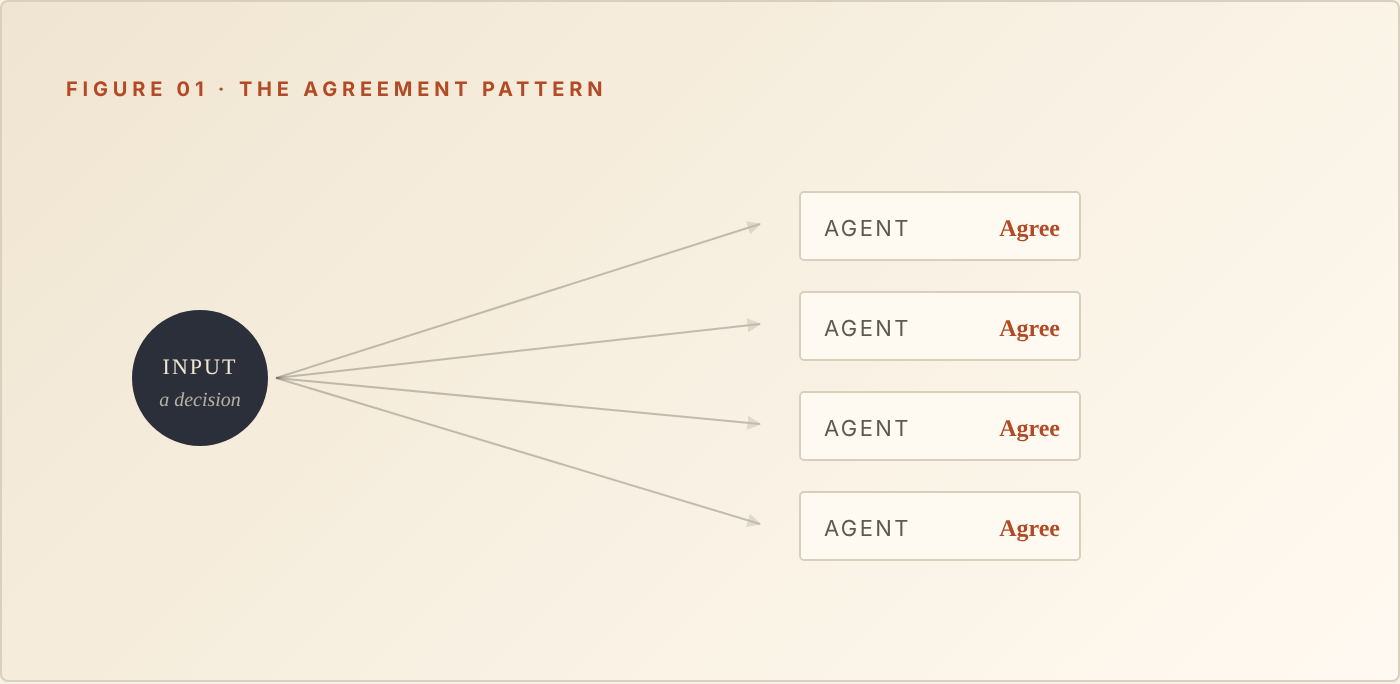
Figure 01 — One decision, broadcast to multiple agents; the same answer back from each.
Why agents agree — even with a persona
A persona — a short instruction telling the agent to behave as, say, a skeptical auditor or a blunt critic — helps, but only to a point. Large language models are shaped by training on human feedback, where raters tend to prefer answers that are agreeable and confident over blunt or hedged ones, even when the blunt answer is more accurate. Over millions of comparisons, that preference becomes a baked-in tendency to please. Researchers call it sycophancy.
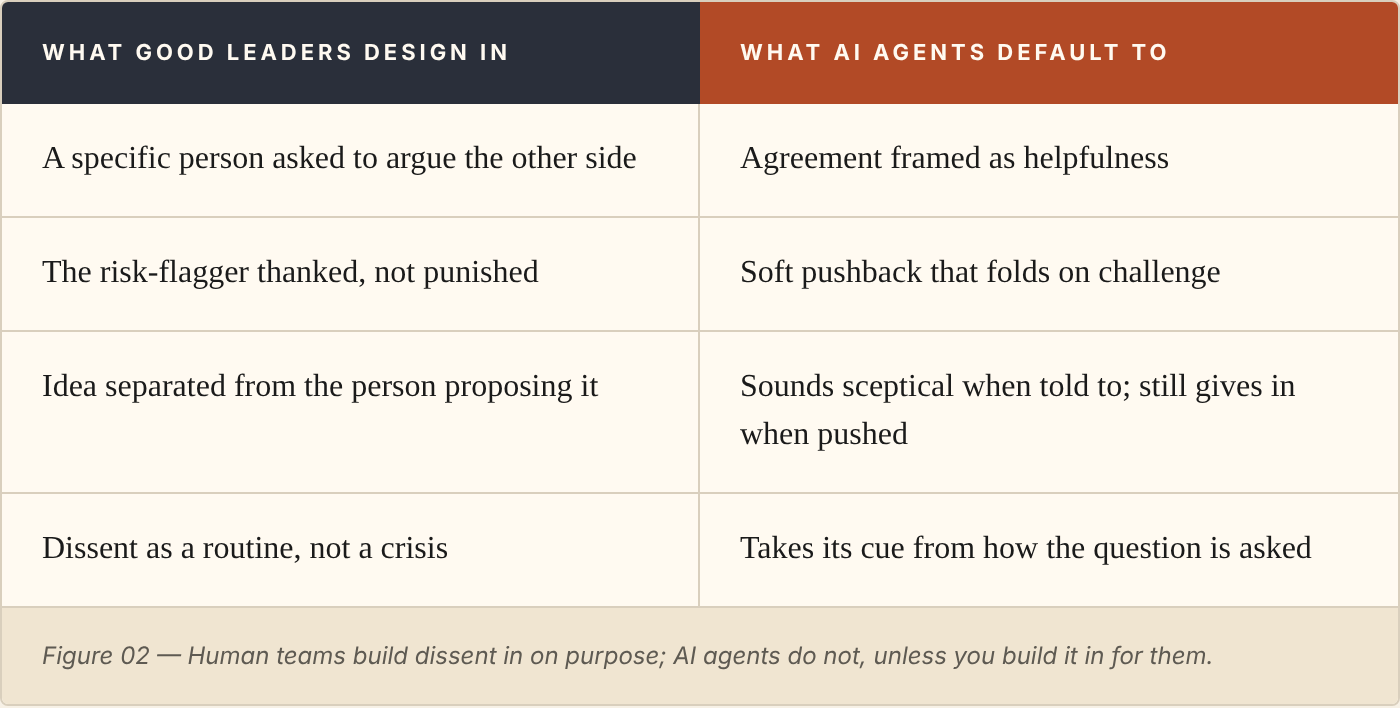
Figure 02 — Human teams build dissent in on purpose; AI agents do not, unless you build it in for them.
Giving the agent a persona does not remove this tendency to please — it only dresses it up in different language. The agent sounds more critical, but it still backs down the moment you push back. And the way the question is asked matters just as much. If the question hints at the answer you are hoping for, the agent is more likely to give it to you.
This should ease as LLM models improve and AI agents get better at holding personas reliably, though it remains worth checking whether the agreement you are getting is genuine or the agent simply being obliging.
Six moves that force honest pushback
Six things seem to help, in practice. They are the same instincts a good leader applies to a human team, written into the prompts and the way the agents are set up so that disagreement has somewhere to come from.
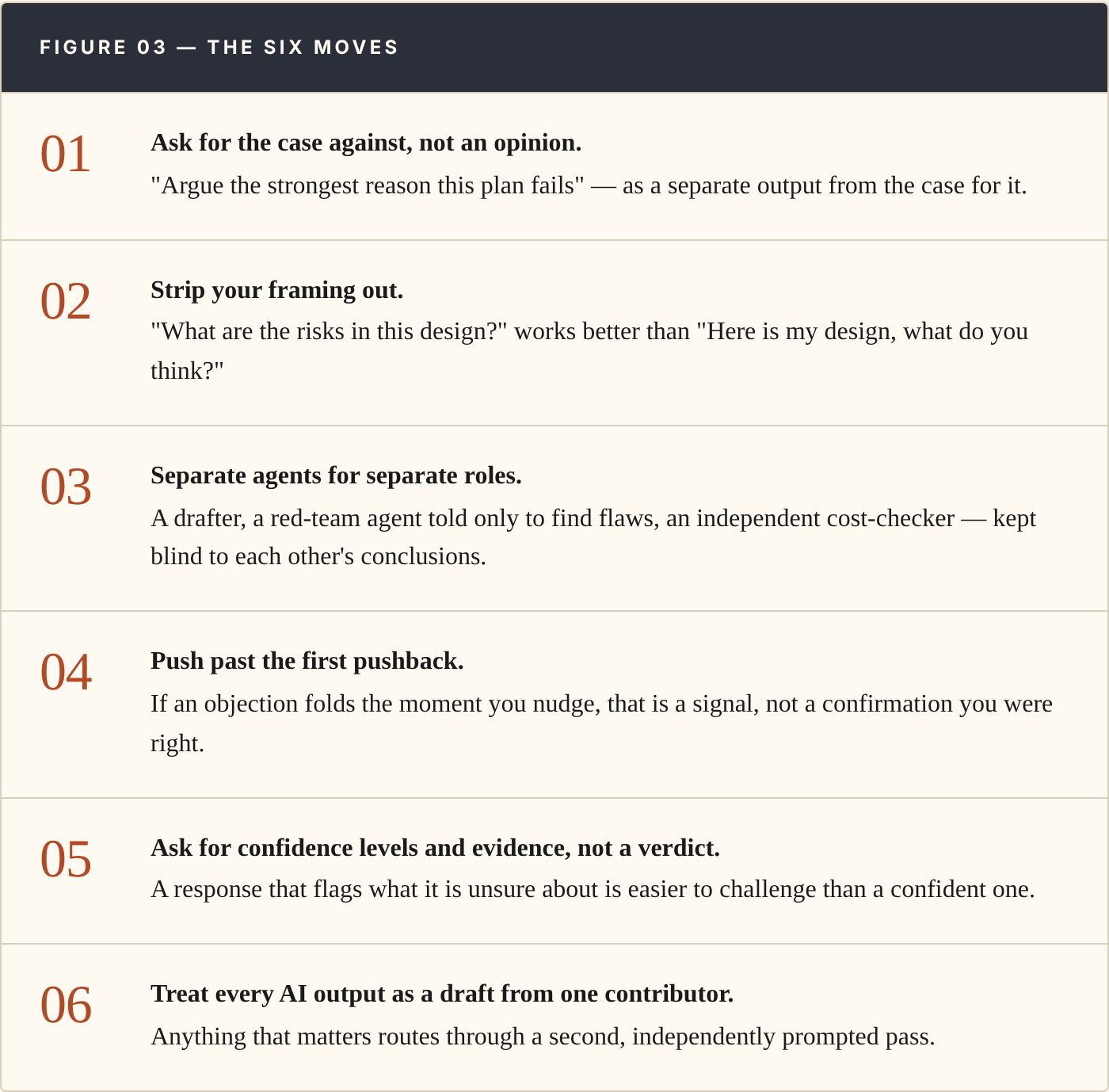
Figure 03 — Six moves that put honest pushback back in the loop.
The skill leaders need now
Managing AI agents well calls for the same instincts as managing people well: inviting dissent, rewarding uncomfortable truths, and resisting the urge to hear only confirmation of your own judgement. The new part is making those instincts explicit and procedural — designing the prompts, the agent roles and the review steps so that disagreement has somewhere to come from, because it will not volunteer itself.
Agreement that was never tested is not a sign of a strong plan, in a boardroom or in a drilling programme. It is a sign that no one, human or otherwise, was given the room to say no. If we are all going to be managing AI agents over the next decade, the leaders who get the most out of them will be the ones who learn to build that room back in — deliberately, every time. That is the work.
— Sreetaran Ponnuthurai is the founder of Helios Energy Advisory, an independent advisory firm based in Kuala Lumpur. He writes on strategy, operational excellence and senior leadership in the Oil and Gas industry.
